
 Media
Media Products
asp article: Customer loyalty tool
- Media, Products
- 6 min reading time
Customer loyalty tool: HV check for battery diagnosis
Diagnostics specialist AVL DiTEST has developed the ‘HV Check’ for the independent repair market. This enables an initial diagnosis of the HV system in electric vehicles to be made in no time at all. Maik Freudenstein uses the device to boost customer loyalty.
For Maik Freudenstein, two things are important: first and foremost, the safety of his employees when working with high-voltage vehicles, and secondly, keeping pace with technological developments. ‘The HV check sends a clear signal to customers that we are also capable of working on electric vehicles,’ says the owner of Freudenstein Autoreparatur und Handel GmbH & Co. KG, a workshop in Edermünde near Kassel. He repairs vehicles of all kinds of brands and is keen to prepare himself for the topic of e-mobility. ‘We have trained our employees accordingly and are acquiring the necessary equipment.’
The 2S training course in accordance with DGUV has been part of the workshop technology training for mechatronics engineers (qualified persons for work on high-voltage systems in a de-energised state) since 2013. One employee at Freudenstein has the 3S certificate and is therefore authorised to work on high-voltage systems under voltage. ‘We are feeling our way into the subject and gaining experience, because at some point the topic of HV vehicles will come up,’ explains Maik Freudenstein during our visit to the site. ‘Of course, most customer vehicles are combustion engines, but every other day we also get a hybrid or battery-electric vehicle,’ says the workshop manager. He doesn't want to have to turn these customers away. Regular maintenance, air conditioning service, tyres and work on the chassis – this has long been part of everyday life for hybrid and battery-electric vehicles (BEVs) too.
Freudenstein also uses AVL DiTEST's HV check as an effective customer loyalty measure, for example as part of regular inspections for electric vehicles. ‘Many electric car owners come in for an inspection and think that there's nothing to do except top up the windscreen washer fluid. Most of them have no idea that an electric car is a complex system,’ says the workshop manager, describing his experience. ‘When customers then look at the bill, many are surprised at everything that's included. We do air conditioning maintenance, we change the brake fluid, the cabin filter is replaced and the axles and joints are checked. We do the HV check as an additional service; it's part of our inspection package for HV vehicles.’
Report with all details
The ‘HV system status report’ is clearly structured and shows at a glance whether everything is OK in green or red (see illustration).
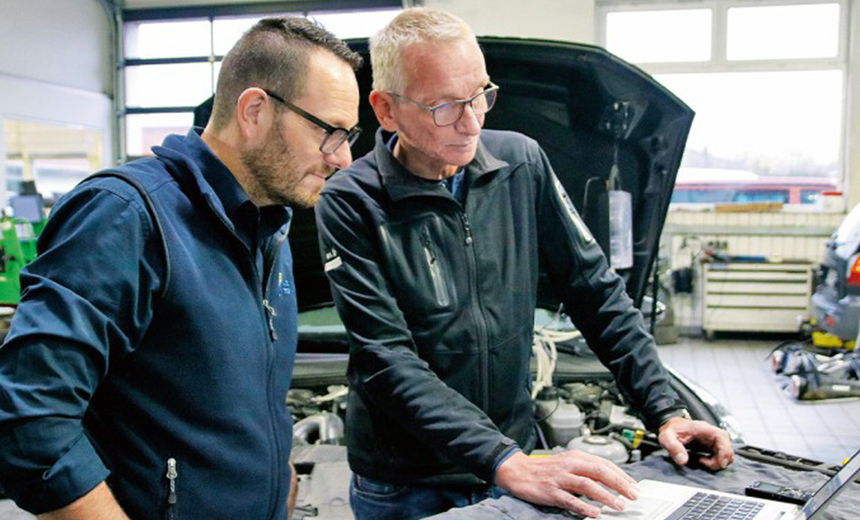
On the second page, the report lists a series of parameters that provide information about the battery status, including insulation resistances, temperatures and temperature differences between cells, the state of health (SoH) of the battery and – if available in the control unit – current error codes. ‘We read the data from the vehicle's battery management system via a VCI interface,’ explains Michael Helmert, sales representative at AVL DiTest, pointing to the values in the log. Once the vehicle connector is plugged into the OBD socket, the actual readout takes only a few seconds; it takes less than two minutes in total before we see the results log on the laptop.
The safety indicators tell the mechatronics engineer whether important parameters such as the insulation resistance of the high-voltage system are OK, whether the vehicle has triggered a crash signal after an accident, or whether the pilot line has been opened.
The state of health is expressed as a percentage and is an indicator of the battery's health. Important to know: The value is read from the vehicle's control unit. It is not determined under load or while the battery is charging. Special systems are available on the market for determining an independent SoH. ‘In the HV check, the SoH is one of many values and certainly not the most important one. We see the HV check as an entry point for the IAM into the topic of battery diagnostics – not least from a safety perspective,’ explains Helmert. ‘Based on the report, the boss can decide which employee is allowed to work on the vehicle.’ If the vehicle comes into the workshop after an accident, it is advisable to check the battery condition. An overheated battery or resistance outliers indicate that the battery has been damaged – in which case, quick action must be taken and the vehicle must be placed in quarantine, for example.
The HV Check was developed by AVL DiTest specifically for the needs of the independent repair market. Currently, more than 300 models are supported, including BEVs and hybrid vehicles from Audi, BMW, Cupra, Ford, Mercedes-Benz, Smart and VW. Other brands are to be added in the near future. Ford and Fiat were recently integrated, and the Stellantis brands are in development. The diagnostic specialists at AVL DiTest benefit from their many years of cooperation with various vehicle manufacturers in their development work. In addition to initial diagnosis with HV-Check, the product portfolio in the field of e-mobility includes numerous other diagnostic and service tools, such as balancers for compensating voltage differences in the battery after individual cells have been replaced, and equipment for leak testing.
Article: Dietmar Winkler, published in asp Auto Service Praxis, on 01.02.2025
- Media
- Products
asp article: Customer loyalty tool
- Media, Products
- 6 min reading time
Customer loyalty tool: HV check for battery diagnosis
Diagnostics specialist AVL DiTEST has developed the ‘HV Check’ for the independent repair market. This enables an initial diagnosis of the HV system in electric vehicles to be made in no time at all. Maik Freudenstein uses the device to boost customer loyalty.
For Maik Freudenstein, two things are important: first and foremost, the safety of his employees when working with high-voltage vehicles, and secondly, keeping pace with technological developments. ‘The HV check sends a clear signal to customers that we are also capable of working on electric vehicles,’ says the owner of Freudenstein Autoreparatur und Handel GmbH & Co. KG, a workshop in Edermünde near Kassel. He repairs vehicles of all kinds of brands and is keen to prepare himself for the topic of e-mobility. ‘We have trained our employees accordingly and are acquiring the necessary equipment.’
The 2S training course in accordance with DGUV has been part of the workshop technology training for mechatronics engineers (qualified persons for work on high-voltage systems in a de-energised state) since 2013. One employee at Freudenstein has the 3S certificate and is therefore authorised to work on high-voltage systems under voltage. ‘We are feeling our way into the subject and gaining experience, because at some point the topic of HV vehicles will come up,’ explains Maik Freudenstein during our visit to the site. ‘Of course, most customer vehicles are combustion engines, but every other day we also get a hybrid or battery-electric vehicle,’ says the workshop manager. He doesn't want to have to turn these customers away. Regular maintenance, air conditioning service, tyres and work on the chassis – this has long been part of everyday life for hybrid and battery-electric vehicles (BEVs) too.
Freudenstein also uses AVL DiTEST's HV check as an effective customer loyalty measure, for example as part of regular inspections for electric vehicles. ‘Many electric car owners come in for an inspection and think that there's nothing to do except top up the windscreen washer fluid. Most of them have no idea that an electric car is a complex system,’ says the workshop manager, describing his experience. ‘When customers then look at the bill, many are surprised at everything that's included. We do air conditioning maintenance, we change the brake fluid, the cabin filter is replaced and the axles and joints are checked. We do the HV check as an additional service; it's part of our inspection package for HV vehicles.’
Report with all details
The ‘HV system status report’ is clearly structured and shows at a glance whether everything is OK in green or red (see illustration).
On the second page, the report lists a series of parameters that provide information about the battery status, including insulation resistances, temperatures and temperature differences between cells, the state of health (SoH) of the battery and – if available in the control unit – current error codes. ‘We read the data from the vehicle's battery management system via a VCI interface,’ explains Michael Helmert, sales representative at AVL DiTest, pointing to the values in the log. Once the vehicle connector is plugged into the OBD socket, the actual readout takes only a few seconds; it takes less than two minutes in total before we see the results log on the laptop.
The safety indicators tell the mechatronics engineer whether important parameters such as the insulation resistance of the high-voltage system are OK, whether the vehicle has triggered a crash signal after an accident, or whether the pilot line has been opened.
The state of health is expressed as a percentage and is an indicator of the battery's health. Important to know: The value is read from the vehicle's control unit. It is not determined under load or while the battery is charging. Special systems are available on the market for determining an independent SoH. ‘In the HV check, the SoH is one of many values and certainly not the most important one. We see the HV check as an entry point for the IAM into the topic of battery diagnostics – not least from a safety perspective,’ explains Helmert. ‘Based on the report, the boss can decide which employee is allowed to work on the vehicle.’ If the vehicle comes into the workshop after an accident, it is advisable to check the battery condition. An overheated battery or resistance outliers indicate that the battery has been damaged – in which case, quick action must be taken and the vehicle must be placed in quarantine, for example.
The HV Check was developed by AVL DiTest specifically for the needs of the independent repair market. Currently, more than 300 models are supported, including BEVs and hybrid vehicles from Audi, BMW, Cupra, Ford, Mercedes-Benz, Smart and VW. Other brands are to be added in the near future. Ford and Fiat were recently integrated, and the Stellantis brands are in development. The diagnostic specialists at AVL DiTest benefit from their many years of cooperation with various vehicle manufacturers in their development work. In addition to initial diagnosis with HV-Check, the product portfolio in the field of e-mobility includes numerous other diagnostic and service tools, such as balancers for compensating voltage differences in the battery after individual cells have been replaced, and equipment for leak testing.
Article: Dietmar Winkler, published in asp Auto Service Praxis, on 01.02.2025
