

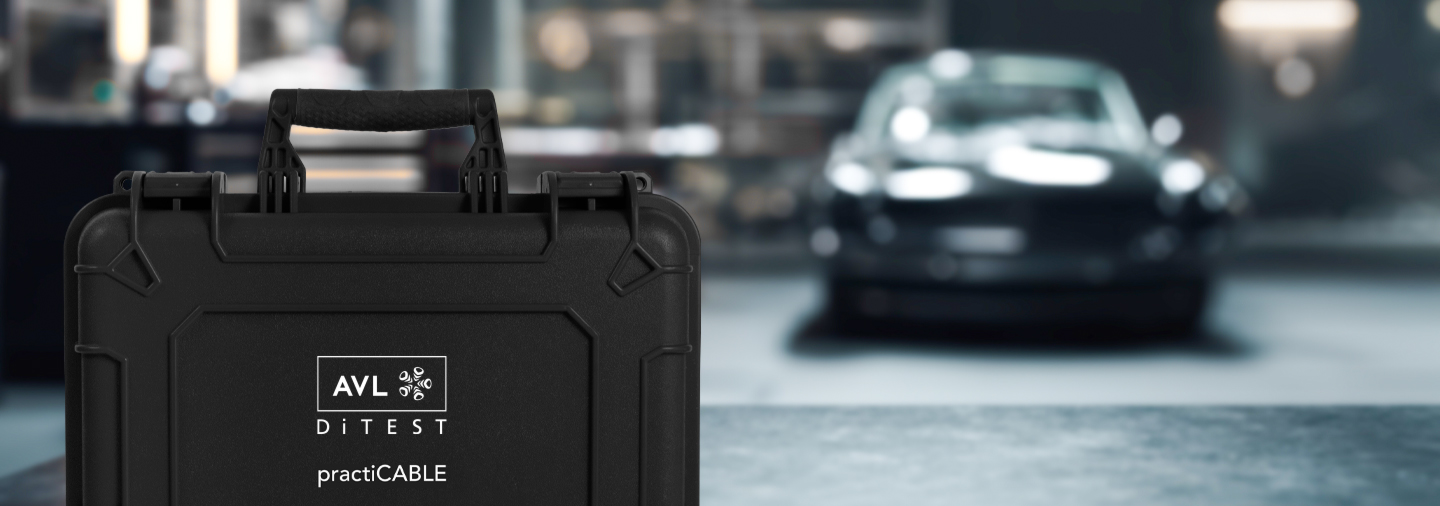
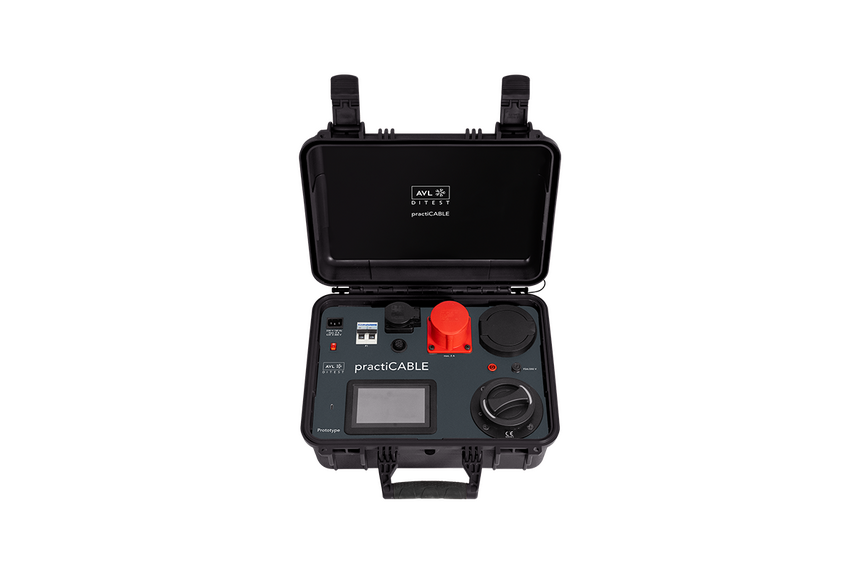
AVL DiTEST practiCABLE
The AVL DiTEST practiCABLE allows you to automate the inspection of Mode 2 (IC-CPD) and Mode 3 charging cables for electric vehicles in just a few minutes. The practical standalone case solution enables complete safety and functional testing according to current standards and guidelines (DGUV Regulation 3, EN 50699, EN 62752, etc.) without the need for additional test equipment.
Its simple design and intuitive operation make your work effortless and efficient. Select from predefined test plans that comply with manufacturers' specifications or create individual autotest sequences and test plans according to your requirements. You can transfer the recorded measured values quickly and easily via Bluetooth or USB and generate clear reports.
Advantages at a glance
- Inspection of charging cables for electric vehicles in line with DGUV Regulation 3 (inspection of mobile electrical equipment)
- Automated test procedures: Plug in – Start – Finished
- Mode 2 (IC-CPD) and Mode 3 charging cables with type 2 or type 1 plugs
- Compatible with all standard single and 3-phase mains plugs (Schuko, CEE 16/32A)
- Easy to set up and intuitive to use
- Predefined test plans according to manufacturers' specifications or customised autotest sequences
- Evaluation of test results based on standards-compliant or individually selected limits
- Measured values can be transferred via Bluetooth and USB-C
Available measurements Mode 2
- Visual inspection checklist
- Protective conductor resistance (3 mA, 200 mA)
- Protective conductor connection housing
- Insulation resistance (250 V, 500 V)
- RCD-AC tripping time and current (10 mA, 30 mA)
- RCD-A tripping time and current (10 mA, 30 mA)
- RCD-DD tripping time and current (6 mA)
- Incorrect wiring & line interruption
- Earth leakage current
- Contact current
- Proximity Pilot
- CP signal analysis (states A, B, C)
- Simulation of communication errors
Available measurements Mode 3
- Visual inspection checklist
- Protective conductor resistance (200 mA)
- Continuity of all conductors
- Insulation resistance between all conductors
- Proximity Pilot
